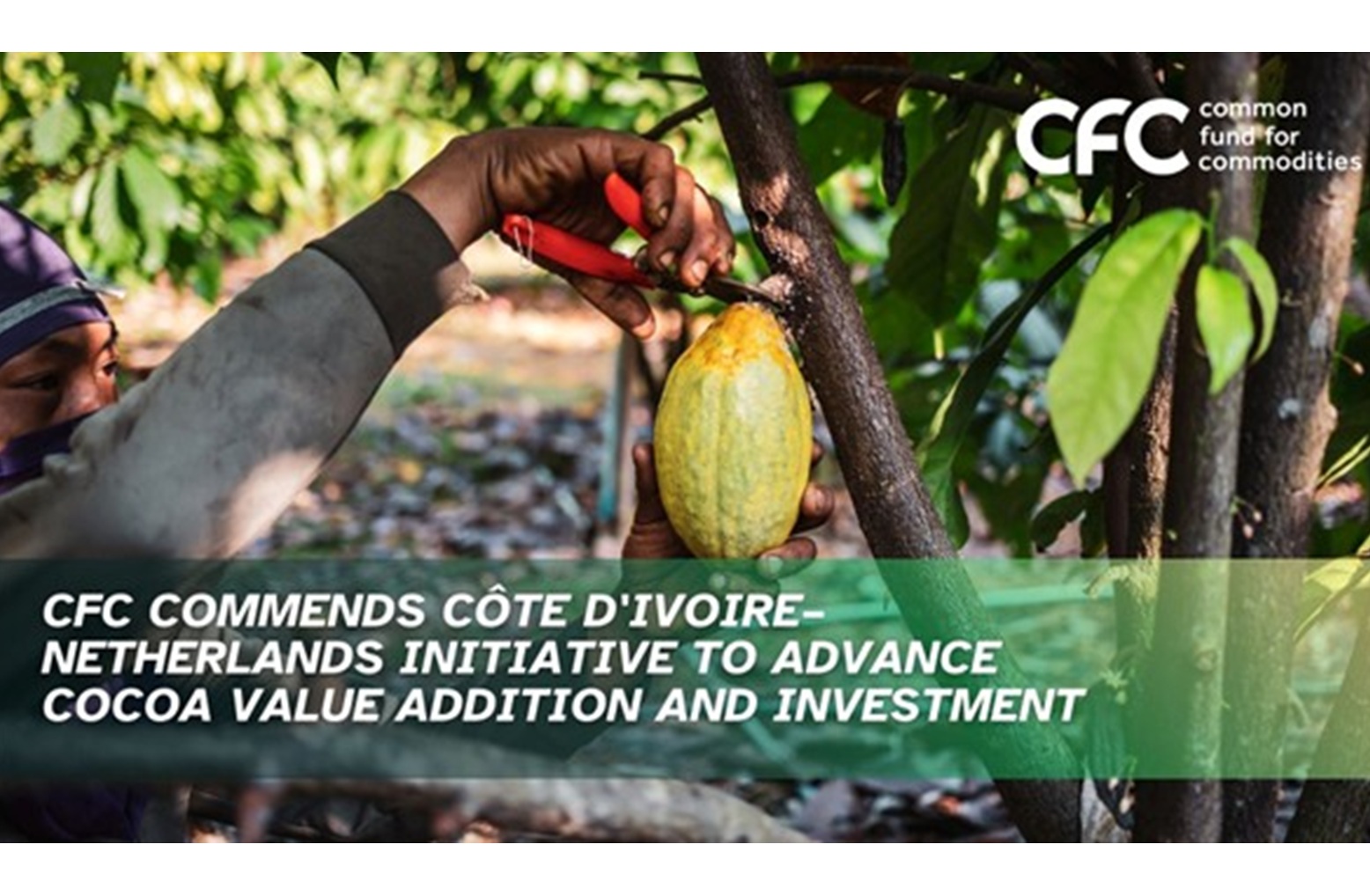
CFC Commends Côte d'Ivoire–Netherlands Initiative to Advance Cocoa Value Addition and Investment
The Common Fund for Commodities (CFC) welcomes the recent announcement by the Governments of Côte d'Ivoire and the Kingdom of the Netherlands to deepen their economic partnership through new investments in cocoa processing and the organization of the Côte d'Ivoire Business Forum, to be held on 14 September 2026 in The Hague.
The initiative reflects a shared commitment to promoting sustainable industrial development, strengthening commodity value chains and creating greater value addition in producing countries—objectives that closely align with the CFC's mission of fostering inclusive and sustainable commodity-dependent economies.
Highlighting Côte d'Ivoire's long-term vision for the sector, Kalil Konaté, Minister of Trade, Industry and Handicrafts of Côte d'Ivoire, stated that the country's ambition is to move beyond being the world's leading cocoa producer to becoming a global leader in the processing and export of finished cocoa products. He also welcomed the Netherlands' support for industrial development and the strengthening of commercial partnerships between the two countries.
According to the announcement, the partnership will include the development of a new cocoa processing facility in San Pedro, while the upcoming Business Forum will showcase investment opportunities in Côte d'Ivoire to Dutch companies and investors. The Netherlands also reaffirmed its support for Côte d'Ivoire's National Development Plan 2026–2030.
As the world's largest cocoa producer, Côte d'Ivoire continues to pursue an ambitious strategy to increase domestic processing, create higher-value exports and strengthen local industries. Expanding investment in processing capacity and agribusiness represents an important step toward ensuring that a greater share of value generated from commodities remains within producing countries.
The Netherlands has long played a strategic role in global agricultural and commodity trade. As one of Europe's leading gateways for cocoa imports, processing and international trade, the country serves as a vital bridge between producing countries and international markets, making it a natural partner for initiatives that strengthen resilient and sustainable cocoa value chains.
"Sustainable development begins with ensuring that producing countries capture a greater share of the value created from their natural resources," said Ambassador Sheikh Mohammed Belal, Managing Director of the Common Fund for Commodities. "The partnership between Côte d'Ivoire and the Netherlands demonstrates how international cooperation can catalyse industrial development, attract responsible investment and strengthen resilient commodity value chains. The upcoming Business Forum in The Hague provides an important platform to connect governments, investors and businesses in pursuit of shared prosperity, and the CFC welcomes initiatives that mobilize investment, strengthen local value addition and create sustainable economic opportunities that improve the livelihoods of smallholder farmers and commodity-dependent communities."
The Côte d'Ivoire Business Forum, scheduled for 14 September 2026 in The Hague, provides a timely platform to foster dialogue between governments and businesses, encourage productive investment and explore new opportunities across agribusiness, agro-processing, innovation and industrial development.
The CFC encourages stakeholders from across the commodity sector—including investors, agribusinesses, development finance institutions and strategic partners—to participate in the Forum and engage in initiatives that advance sustainable value addition, strengthen local processing capacity and build more resilient global commodity value chains.
Through more than three decades of financing high-impact commodity development initiatives, the CFC remains committed to working with governments, development partners and the private sector to catalyse investment that generates lasting economic, social and environmental benefits for commodity-dependent communities worldwide.