CFC and Build Bangladesh explore opportunities for impact investment and climate resilience
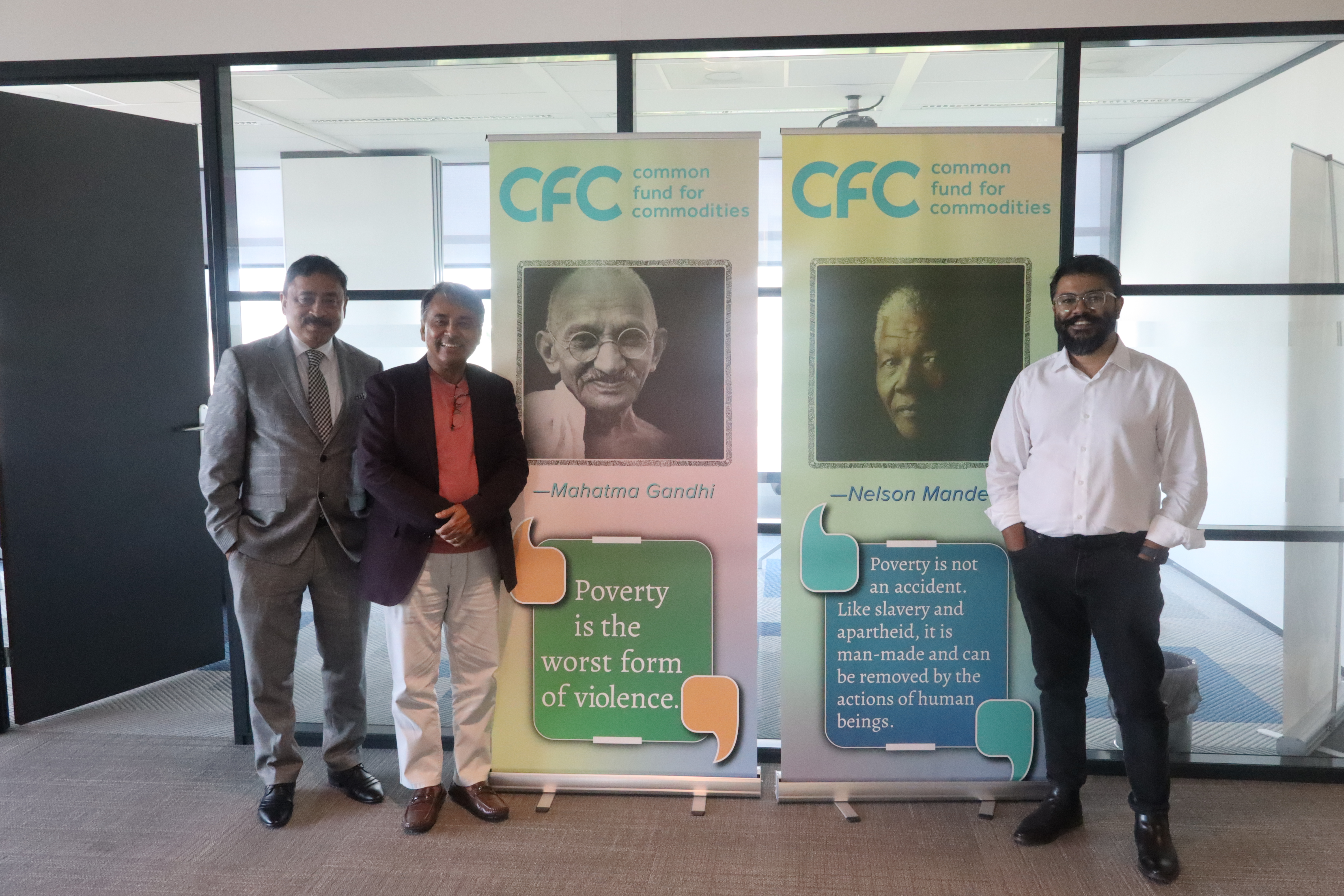
Amsterdam, 18 September 2026 — he Common Fund for Commodities (CFC) welcomed Mr. Farhad Reza, Managing Director of Build Bangladesh, and Mr. Erad Kawsar, Director and Board Member of Build Bangladesh, for a visit to the CFC Secretariat to exchange views on impact investment, innovative finance and opportunities to strengthen collaboration in Bangladesh.
Build Bangladesh is an impact investment platform working to mainstream impact investment in Bangladesh, with a focus on generating financial returns alongside positive social and environmental outcomes.
The visit began with a discussion with Mr. Hector Besong, Risk Manager at the CFC, focusing on risk management and approaches to de-risking investments, including the challenges associated with financing in local currencies. The discussion explored how appropriate risk-sharing and financial structures can help unlock investment in enterprises operating in developing-country markets, where access to suitable local-currency financing remains a significant constraint.
The Build Bangladesh delegation then presented its experience in developing and investing in solutions that address pressing environmental and social challenges in Bangladesh. Among the examples highlighted was the Prokriti o Paani (PoP) Water Tower, a climate-resilient, zero-energy water system designed to provide clean drinking water to underserved communities in the country’s hilly regions.
The PoP Water Tower uses sustainable and locally sourced materials, including bamboo, to capture water from rain, humidity and clouds without relying on electricity or external power. The system can produce approximately 10,000 litres of water per week and has a 50,000-litre reservoir capacity, providing communities with access to water throughout the year. The initiative has been designed particularly for indigenous communities in areas including the Chittagong Hill Tracts and Bandarban.
Beyond water access, the project has significant social and economic dimensions. By reducing the time communities—particularly women and girls—spend walking long distances to collect unsafe water, the initiative has saved an estimated 60,000 collective hours, creating more time for education and income-generating activities. Build Bangladesh is also exploring models for local sustainability through the sale of surplus water to tourists and the use of excess supply for agriculture.
The delegation also met with Mr. Peter Nielsen, Impact Investment Manager at the CFC, for discussions on the potential for carbon sequestration and biodiversity-related investment opportunities in Bangladesh. Particular attention was given to the potential of mangrove ecosystems in the southern region of Bangladesh, which can provide important climate, biodiversity and livelihood benefits while offering opportunities to explore innovative investment models.
The visit concluded with a meeting with CFC Managing Director H.E. Ambassador Sheikh Mohammed Belal, who highlighted the CFC’s Humanizing the Value Chains approach and the importance of connecting investment with the people and communities behind commodity value chains.
Ambassador Belal encouraged Build Bangladesh to explore opportunities to connect the CFC with potential partners and enterprises in Bangladesh, including businesses working in sectors such as garments, coffee and other commodity-related value chains.
“Humanizing Value Chains is about looking beyond the commodity itself and understanding the people, enterprises and communities behind it. Bangladesh has a strong private sector and a growing ecosystem of impact-oriented businesses. We would welcome the opportunity to connect with partners who can help us identify where CFC investment, technical assistance and partnerships can generate meaningful value for producers and communities.” — H.E. Ambassador Sheikh Mohammed Belal, Managing Director, Common Fund for Commodities
Mr. Farhad Reza, Managing Director of Build Bangladesh congratulated Ambassador Belal for his innovative but highly humane idea and assured that Build Bangladesh will surely explore opportunities to pilot this idea in Bangladesh as well.
The discussions provided a valuable exchange on how impact investment, innovative financing, climate resilience, biodiversity and commodity value-chain development can come together to support sustainable development in Bangladesh.
The CFC and Build Bangladesh agreed to remain engaged in exploring areas of mutual interest, including opportunities to connect innovative Bangladeshi enterprises with CFC financing, technical assistance and international partnerships.
About the Common Fund for Commodities
The Common Fund for Commodities (CFC) is a UN-affiliated international financial institution headquartered in Amsterdam. Established in 1989 following the work of the United Nations Conference on Trade and Development (UNCTAD), the CFC provides investment and technical assistance to support sustainable commodity development in developing countries.