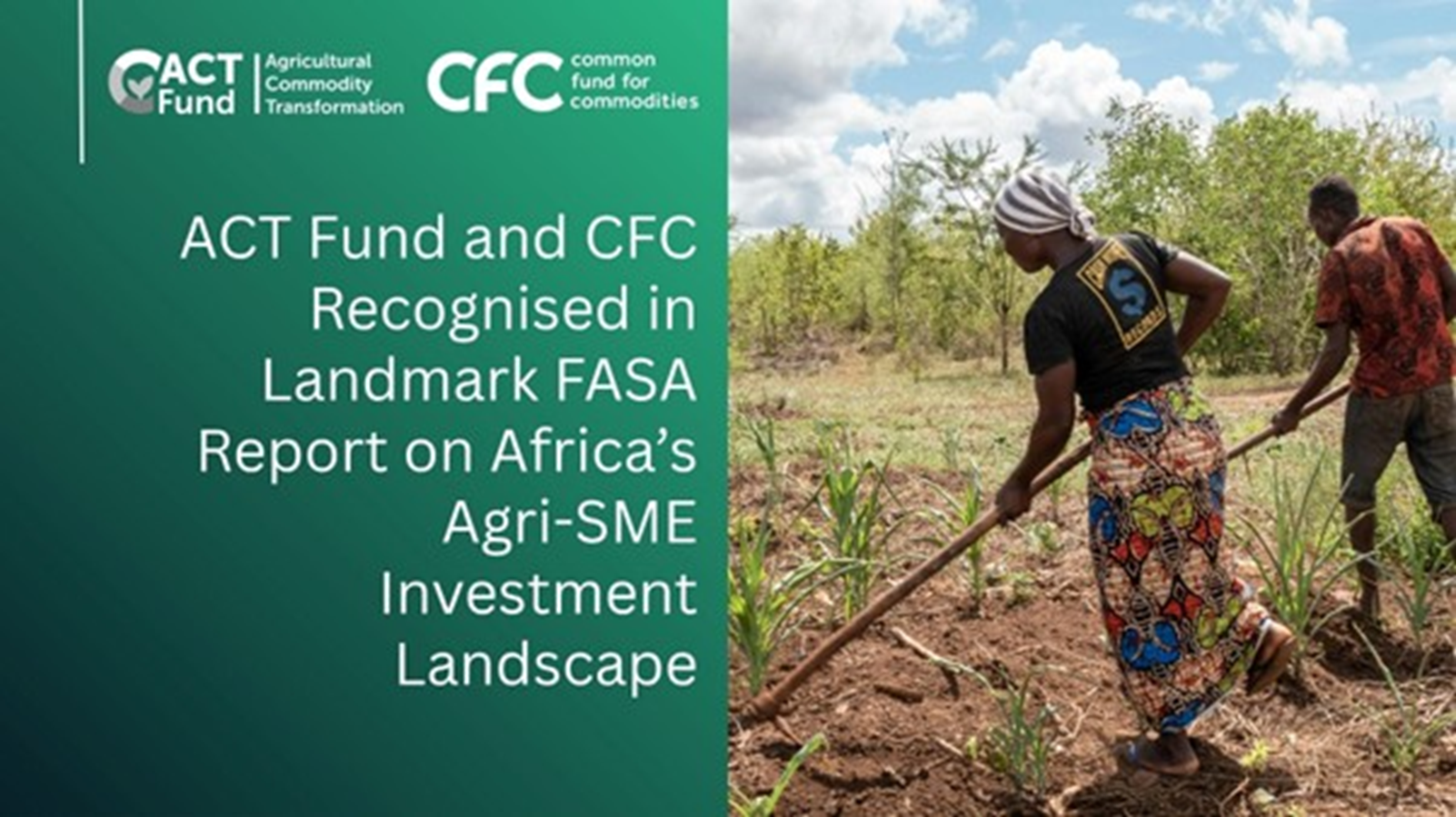
ACT Fund and CFC Recognised in Landmark FASA Report on Africa’s Agri-SME Investment Landscape
The Agricultural Commodity Transformation (ACT) Fund and the Common Fund for Commodities (CFC) have been recognised in the newly released report, The Landscape of Agri-SME Funds in Africa, published by Financing for Agri-SMEs in Africa (FASA).
The report provides one of the most comprehensive overviews to date of the investment ecosystem supporting agricultural small and medium enterprises (agri-SMEs) across Africa. It maps 175 investment funds and analyses 79 data points for each fund, covering both established funds and those currently fundraising. The publication highlights the growing momentum behind catalytic financing solutions designed to bridge the long-standing financing gap facing Africa’s agricultural enterprises.
For the ACT Fund and CFC, inclusion in this landmark publication reflects continued efforts to strengthen agricultural value chains, expand access to finance, and promote inclusive economic growth across the continent. The recognition is particularly noteworthy given that the report identifies 175 funds active in Africa's agri-SME financing ecosystem, underscoring the growing visibility of ACT Fund and CFC as catalytic partners in advancing sustainable agricultural transformation."
Spotlight on Catalytic Capital
The FASA report underscores a critical challenge facing African agriculture. While agri-SMEs are central to food security, employment creation, value addition, and rural economic development, many remain underserved by conventional financing systems.
According to the report, Africa’s agri-SMEs face an estimated financing gap of approximately USD 100 billion. Many businesses are considered too large for microfinance institutions yet too risky for traditional commercial lenders, creating a significant “missing middle” in agricultural finance.
Against this backdrop, catalytic and patient capital have emerged as increasingly important tools for unlocking investment into the sector. The report highlights the growing role played by impact-focused funds, development finance institutions, and blended finance mechanisms in supporting agricultural transformation across Africa.
The inclusion of the ACT Fund and CFC reflects the growing recognition of institutions that are helping to de-risk agricultural investment while supporting enterprises that create jobs, improve livelihoods, strengthen food systems, and build long-term economic resilience.
Supporting Africa’s Agricultural Transformation
Agricultural SMEs play a central role in African economies. They connect farmers to markets, support processing and distribution, drive innovation, and generate employment throughout commodity value chains.
The FASA report notes that these enterprises are essential to building resilient food systems capable of responding to climate challenges, supply chain disruptions, and growing food demand.
Through its financing and development initiatives, CFC has consistently championed investments that promote sustainable commodity production, climate resilience, value addition at origin, and inclusive market participation. The ACT Fund similarly contributes to advancing innovative financing solutions that enable agricultural enterprises to scale sustainably while creating lasting social and economic impact.
Beyond financing enterprises, investments in agri-SMEs contribute directly to the broader objective of humanizing value chains. By strengthening local businesses that connect producers to markets, process commodities closer to origin, and create employment opportunities in rural communities, agri-SMEs help ensure that greater value remains where commodities are produced. This approach aligns closely with CFC’s vision of building value chains that work not only for products and profits, but also for people, communities, and sustainable livelihoods.
The recognition by FASA comes at a time when global attention is increasingly focused on strengthening local agricultural ecosystems and improving access to finance for enterprises operating across agricultural value chains.
A Growing Ecosystem of Impact Investors
The report points to the emergence of a new generation of Africa-focused investment managers and blended finance initiatives that are bringing more tailored, flexible, and locally informed financing approaches to the market.
FASA itself was established as a multi-donor initiative designed to unlock financing for agricultural SMEs across Africa by supporting investment funds active in the sector. The initiative seeks to mobilise catalytic capital and attract greater levels of private investment into agricultural businesses.
Mr. Michael van den Berg, Director of the ACT Fund, noted:
"The role of FASA is crucial in unlocking capital for the agricultural sector. With this publication, they once again demonstrate how important it is to bridge the financing gap that the sector continues to face."
By highlighting organisations and funds contributing to this ecosystem, the report provides valuable insights into how innovative financing partnerships can help close financing gaps and accelerate sustainable agricultural growth.
Advancing Inclusive and Sustainable Development
For the ACT Fund and CFC, the recognition reinforces the importance of collaborative approaches to financing sustainable development.
Mr. Michael van den Berg added:
"The FASA report highlights both the scale of the financing challenge facing agricultural SMEs and the growing momentum behind innovative financing solutions. The ACT Fund was established to help address this gap by providing flexible capital to businesses that are creating economic value while strengthening food security, climate resilience, and sustainable agricultural production. We are proud to see our work recognised as part of this broader effort to build stronger agricultural value chains across Africa."
Investments in agri-SMEs not only strengthen food security and rural livelihoods but also contribute to climate adaptation, gender inclusion, value addition, and long-term economic resilience. At a time when the world faces the interconnected challenges of climate change, biodiversity loss, and ecosystem degradation, such investments are increasingly important for scaling nature-based solutions. By enabling regenerative agriculture, agroforestry, sustainable land management, and restoration initiatives, agri-SMEs can become powerful agents of change—helping to humanize value chains while ensuring that economic growth, environmental stewardship, and community well-being advance hand in hand.
The report’s findings are particularly relevant for some of the world’s most vulnerable agricultural economies, including several countries belonging to the Absolute Sixteens (A16) group of nations that are simultaneously Least Developed Countries (LDCs) and Landlocked Developing Countries (LLDCs), where access to finance remains one of the most significant constraints to agricultural transformation.
As Africa’s agricultural finance ecosystem continues to evolve, the ACT Fund and CFC remain committed to supporting impactful investments that empower agricultural enterprises, strengthen commodity value chains, and contribute to sustainable development outcomes across the continent.
The inclusion in the FASA report highlights the growing importance of catalytic finance institutions in shaping the future of African agriculture. By mobilising patient capital, strengthening agri-SMEs, supporting nature-based solutions, and fostering more equitable and resilient value chains, such initiatives contribute not only to agricultural growth but also to the broader goal of ensuring that prosperity generated along commodity value chains reaches the farmers, workers, SMEs, and communities at their foundation.
About the ACT Fund
The Agricultural Commodity Transformation (ACT) Fund is an impact investment fund providing catalytic finance to agricultural SMEs across developing countries. By supporting food security, climate resilience, value addition, regenerative agriculture, nature-based solutions, and biodiversity conservation, the Fund helps create stronger businesses, stronger farming communities, and more resilient agricultural value chains.
About the Common Fund for Commodities (CFC)
The Common Fund for Commodities (CFC) is a UN-affiliated international financial institution with 101 Member States. Through investments in commodity value chains, the CFC supports smallholders, workers, and SMEs while advancing sustainable development, nature-based solutions, biodiversity conservation, and the broader objective of humanizing the value chains. By fostering partnerships between the Global South and the Global North, the CFC promotes innovation, technology transfer, value addition at origin, and shared responsibility for building more resilient, equitable, and sustainable global value chains.